
Forest seedlings delivered for planting
Here you find statistics on forest seedlings delivered for planting. We publish the results by for tree species, method of production, and by origin of seedlings and use of plant protection.
On a yearly basis, since 1998, the Swedish Forest Agency undertakes a survey about produced seedlings for usage in Sweden. The questionnaire is sent to all companies registered at the Swedish Forest Agency as producers or dealers with seedlings. Forest seedlings delivered for planting refer to the plants that have been delivered for use (planting) in Sweden.
Our statistical database contains statistics from Swedish Forest Agency. Produce a table by selecting your subject and variables.
Decrease in forest seedlings delivered for planting in 2025
In 2025, 386 million forest seedlings were delivered, which is a decrease of 19 million (5 percent) from 2024.
The amount of delivered seedlings of Scots pine decreased by 13 million, to 206 million (6 percent), compared to 2024. The number of delivered seedlings of Norway spruce was just over 155 million in 2025, which is a decrease by 11 million compared to 2024.
Delivered seedlings of birch (668 million) increased by 75 percent, compared to 2024. The number of delivered seedlings of birch has increased steadily since 2017 and has increased six-fold. After declining for a couple of years, delivered seedlings of other broadleaf species (1.9 million) increased by 20 percent compared to 2024.
The number of delivered seedlings of Sitka spruce and other coniferous species increased by 31 and 27 percent respectively, compared to 2024. The number of Larch seedlings decreased by 14 percent. However, none of these four tree species categories account for more than one percent of the total quantity of delivered seedlings in 2025.
Delivered seedlings of Lodgepole pine increased by just over 2 million plants (25 percent) in 2025 compared to 2024.

In 2025, Scots pine accounted for 53.4 percent of delivered seedlings and Norway Spruce for 40.3 percent. In 2020, Scots pine took over the position as the most common tree species among delivered forest plants from Norway Spruce. Delivered seedlings of Norway spruce and Scots pine together constitute 94 percent of the total number of delivered forest seedlings for planting, which is a decrease by 2 percent compared to 2024. Delivered seedlings of Lodgepole pine represent 2.8 percent and birch 1.7 percent. Larch, Sitka spruce and seedlings of other conifers and broadleaf species each make up less than 1 percent of the number of delivered forest seedlings.
However, the above-mentioned proportions do not represent the distribution of tree species in the in future forests. This is due to the fact that a significant part of Scots pine and almost all birch and most of other broadleaf trees in the forest have been rejuvenated naturally.
Container-rooted dominates the method of production
Container-rooted is the dominant method of production for forest seedlings. In 2025, container-rooted seedlings accounted for 90 percent of all delivered forest seedlings. Bare-rooted seedlings amounted to 6 percent.
From 2019, a new category called hybrid seedling can be reported as method of production. In 2025, a total of 4 percent of delivered forest seedlings were produced as hybrid seedlings.
Scots Pine and Lodgepole pine are almost exclusively produced as container-rooted seedlings. The proportion of Norway spruce seedlings that were produced using container-rooted method of production in 2025 was 80 percent.
Including hybrid seedlings 95 percent of Sitka spruce and 68 percent of other conifers were produced as bare root. The corresponding figures for Larch and Norway spruce were 43 and 20 percent. Scots Pine produced as bare root accounts for only 0.5 percent. In 2025, 92 percent of other broadleaved trees and 40 percent of birch were produced as bare-rooted seedlings.
Propagation methods for forest plants
As of 2019, it is reported whether delivered forest plants have been propagated from seed or propagated vegetatively. Overall, delivered seedlings of conifers are propagated from seed in almost 100 percent of cases and the vegetatively propagated proportion is very small.
Vegetative propagation of delivered seedlings is mainly used for broad-leaved tree species. In 2025, 29 percent of the delivered seedlings of broad-leaved trees were vegetatively propagated. Of these, mainly hybrid aspen and poplar are propagated vegetatively.
Mechanical protection of seedlings larger than unprotected
The proportion of seedlings that are delivered with some form of protection against beetles (mechanical or chemical) has increased since 2016. In 2025, 72, 48 and 17 percent of the delivered seedlings of Norway spruce, Scots pine and Lodgepole pine respectively were equipped with beetle protection. The use of insecticides on the delivered seedlings of Norway spruce Scots pine remains at the same level as in 2024 (4 and 1 percent respectively).
The proportion of coniferous seedlings delivered with some sort of protection against insects (mechanical) has increased steadily, from 27 percent in 2016 to 55 percent in 2025. During the same period, the proportion of insecticide-treated seedlings has decreased from 18 to 2 percent while the proportion of plants without treatment has decreased from 55 percent in 2016 to 43 percent in 2025. It is not possible to use these statistics to distinguish where in the country protected and unprotected plants are used.
Mainly Swedish origin for seedlings
Seeds are divided into seeds from forest stands and plantation seeds from specially designed seed plantations (seed farms).
Of the forest seedlings delivered in 2025, 97 percent originated from plantation seed and 3 percent from forest stands. Scots Pine seedlings originated almost exclusively from plantation seed. The tree species with the highest proportion of seed stock were other deciduous trees. In 69 percent of the cases, the seedling originated from seeds from forest stands.
Plantation seed from Sweden accounted for the origin of approximately 86 percent of the forest plants in 2025. Almost 11 percent originated from foreign plantation seeds. The seedlings from forest stand seed originated in 0.5 percent of the cases from Sweden and in about 3 percent of the cases from abroad.
Forest seedlings imported to Sweden in 2024
The figures below are based on data from 2004 until 2022. The two-year backlog is a consequence of the Swedish Forestry Agency's registration of the import of seedlings and seeds. These data are not part of the official statistics on delivered forest seedlings.
Within the EU, there is free trade for forest seedlings and seeds. However, there is an obligation to notify the Swedish Forestry Agency regarding the import and export of seedlings and seeds. The import of forest seedlings and seeds from countries outside the EU is permitted for certain countries, such as Norway. For these countries it is obligatory with both a notification and permit.
Seedlings and seeds brought into Sweden from other countries can, but do not have to, have their origin in the sending country. A significant proportion of imported material is of Swedish origin, but some step in the production has taken place in another country.
Import of seedlings
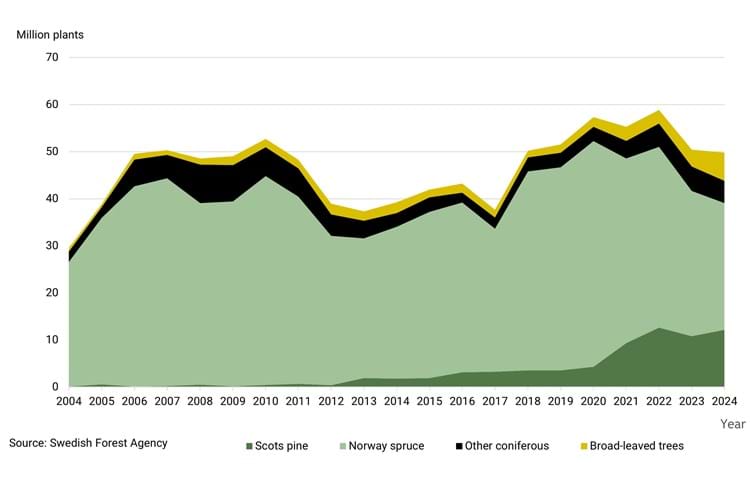
In 2024, 50.0 million seedlings were brought into Sweden from other countries. This means that approximately 12 percent of the seedlings delivered in 2024 (405 million plants in total) were at least partially produced outside Sweden. However, it is unclear whether the plants were considered delivered in the same year as they were imported.
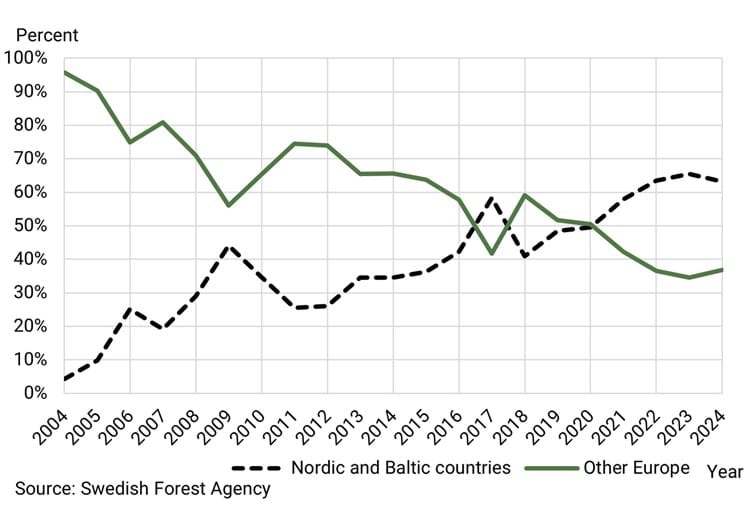
In 2024, most seedlings were brought to Sweden from the Nordic countries (50 percent) followed by Germany and the Baltic countries (34 and 16 percent respectively). Seedlings from the rest of Europe accounted for less than 0.5 percent of the imports. Since 2018, the proportion of plants imported from the Nordic countries has increased steadily, while the proportions from Germany and the Baltics have decreased. During this period, the proportion of plants from the rest of Europe has also decreased.
Figure 8 Share of imported seedlings by origin
The import of seedlings is dominated by Norway spruce. However, the proportion of Norway spruce seedlings has fallen from 84 percent in 2020 to 54 percent in 2024. During the same period the proportion of imported Scots pine seedlings has increased from 7 percent to 24 percent. Among other tree species, larch is the most common (7 percent).
Figure 9 Number of imported seedlings by tree species
The statistics refer to seedlings and seeds for use in Sweden.